Shell-cracking turtles defied mass extinction at the end of the Cretaceous period
Urwelt-Museum Oberfranken, 25.03.2026
The asteroid impact at the end of the Cretaceous period caused one of the largest mass extinctions in Earth’s history. But some organisms defied the catastrophe. For turtles, the chance of survival was apparently linked to their diet: species with a preference for hard-shelled organisms survived the catastrophic event. SNSB paleontologist Serjoscha Evers published the results of his study in the journal Biology Letters.
The mass extinction at the boundary between the Cretaceous and Paleogene periods was catastrophic, wiping out much of Life on Earth. Vertebrate groups that dominated at the time, such as dinosaurs and many large marine reptiles, fell victim to the effects of the asteroid impact around 66 million years ago. However, the catastrophe did not affect all organisms to the same extent: turtles, for example, survived with only minimal losses.
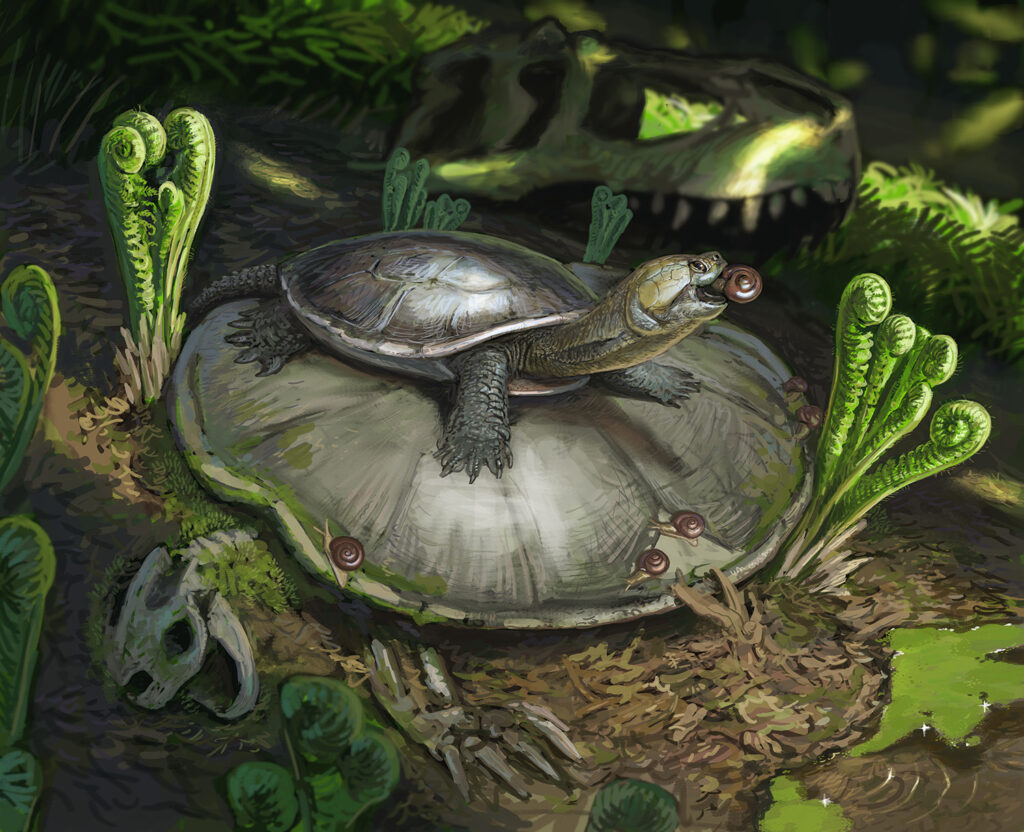
A new study by the research group led by Serjoscha Evers, paleontologist at the Bavarian State Collection of Natural History (SNSB), now shows that turtles that fed on hard-shelled organisms such as gastropods and bivalves survived the mass extinction largely unscathed. And they were more than five times more likely to survive than turtles that hunted fish or were purely herbivorous.
Apparently, this ecological adaptation in turtles had an impact on their probability of survival. “We are observing an ecological filter. Specializing in hard-shelled food gave these turtle species an evolutionary advantage,” explains author Serjoscha Evers. “This is probably due to the resilience of these food sources themselves – mainly gastropods and bivalves – to the catastrophic effects of the impact. Herbivores had difficulty surviving in the nuclear winter following the impact, with effects on the entire food chain, including carnivores. Mollusks and other opportunists, on the other hand, were able to survive well. Turtles that specialized in such prey were therefore under less pressure.”
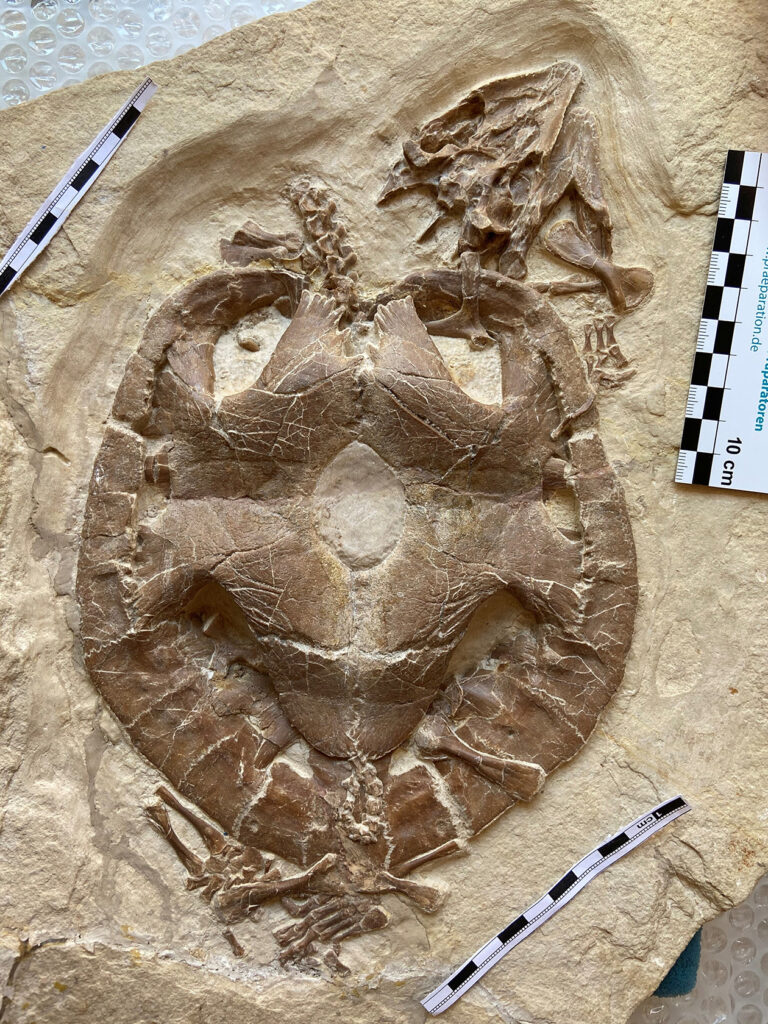
The diet of turtles is revealed by special anatomical features of their jaws. On this basis, Serjoscha Evers and his doctoral student Guilherme Hermanson from the University of Fribourg in Switzerland constructed a large data set that includes all turtle lineages at the Cretaceous-Paleogene boundary. This enabled the paleontologists to use statistical models to assess how diet as an ecological factor influenced the probability of extinction in turtles.
Senior author Serjoscha Evers is director of the Urwelt-Museum Oberfranken, one of ten museums belonging to the Bavarian State Collection of Natural History (SNSB). Guilherme Hermanson is a doctoral student at the University of Fribourg in Switzerland.
Publication:
Guilherme Hermanson, Serjoscha W. Evers; Ecological selectivity of diet on turtle K/Pg survivorship. Biol Lett 1 March 2026; 22 (3): 20250790. https://doi.org/10.1098/rsbl.2025.0790
Scientific Contact:
Dr. Serjoscha Evers
Museumsleitung
SNSB – Urwelt-Museum Oberfranken
Kanzleistraße 1, 95444 Bayreuth
Phone: 049 921 511 211
E-Mail: evers@snsb.de