How Dinosaurs Developed Bird-Like Heads
The transition from dinosaurs to birds is one of the most impressive evolutionary changes in Earth’s history. Paleontologists are now refuting a long-held hypothesis: changes in the structure of the vestibular system in the inner ear at the origin of birds were not a direct adaptation to avian flight. Rather, the fundamental restructuring of the skull led to the changes in the inner ear. An international team of paleontologists has now published the results of the study in the journal PNAS.
On the evolutionary path from dinosaurs to modern birds, it wasn’t just feathers, wings, and eventually active flight that emerged. The skull, brain, and sensory organs also underwent fundamental restructuring. Particularly striking is the change in the shape of the vestibular system in the inner ear. Until now, this was often interpreted as an adaptation of sensory function to the specific demands of balance, spatial orientation, and visual stabilization associated with active flight. An international research team led by paleontologist Guillermo Navalón of the University of Alcalá in Spain has reached a different conclusion: the new mode of locomotion was apparently not the decisive factor behind this transformation in the inner ear. Rather, the fundamental restructuring of the skull—particularly in the area of the craniocervical joint—is responsible for the shape change of the semicircular canals of the inner ear in birds. Serjoscha Evers, palaeontologist at the Bavarian State Collections of Natural History (SNSB), also participated in the study.
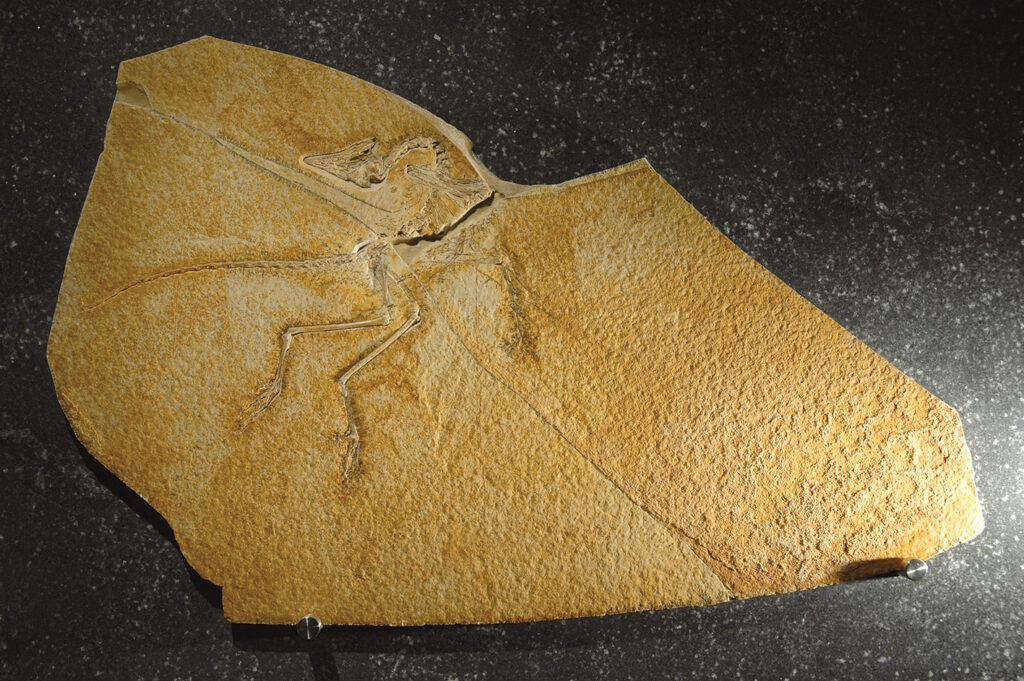
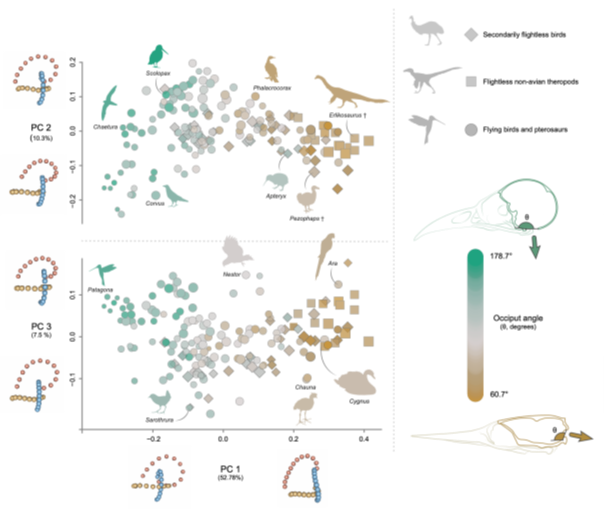
Evers and his colleagues compared the inner ear and skull anatomy of dinosaurs, early birds such as Archaeopteryx, and pterosaurs with that of living and recently extinct birds, including flightless species such as penguins and kiwis. They analyzed the semicircular canals of the inner ear. These fluid-filled tubes detect rotational movements of the head and are thus an important part of the sense of balance. Their bony structure can also be reconstructed in three dimensions in fossilized animals using high-resolution computed tomography.
The result was surprisingly clear: whether a bird can fly or not is only poorly explained by the shape of its semicircular canals. Even the repeated and complete loss of flight ability across different avian lineages left no consistent imprint on their shape. In contrast, the researchers found a much stronger correlation with the architecture of the skull. The reorganization of the head during the dinosaur-to-bird transition is particularly evident in the occiput: In birds, the connection between the skull and the spine increasingly shifted to the underside of the skull. With this realignment, the surrounding skull bones also changed—and with them, the shape of the inner ear. The characteristic “bird-like” inner ear thus does not appear to be an isolated innovation of the sense of balance, but rather part of a more comprehensive restructuring of the head-neck system.
“We tend to interpret striking changes in a sensory organ immediately as a functional adaptation,” says SNSB paleontologist Serjoscha Evers, co-author of the study. “However, the inner ear is not isolated within the skull. When the entire architecture of the head changes, this can also influence the shape of a sensory organ—without this change necessarily being a direct adaptation to a new way of life.”
Publication:
G. Navalón, S.W. Evers, E. Hughes, A. Bjarnason, L.M. Chiappe, S.A. Walsh, J.M. Neenan, E. Panciroli, D.J. Field, & R.B.J. Benson, Coordinated transformations of the labyrinth and occiput during the dinosaur–bird transition, Proc. Natl. Acad. Sci. U.S.A. 123 (42) e2612503123, https://doi.org/10.1073/pnas.2612503123 (2026).
Scientific Contact:
Dr. Serjoscha Evers
SNSB – Urwelt-Museum Oberfranken
Tel.: 049 155 6390 1064, E-Mail: evers@snsb.de