Press Releases

After the Fall of Rome: How the Population of Central Europe Emerged

29. April 2026 | Press Releases
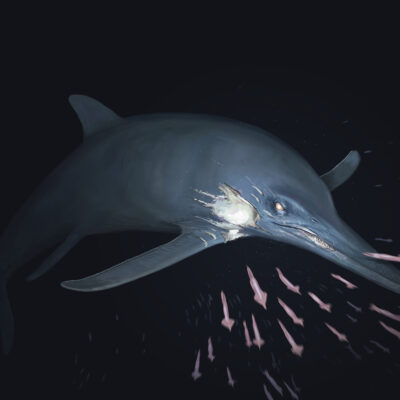
Munich, 29.04.2026 An international study based on Bavarian findings shows that southern Germany‘s population after the collapse of the Roman Empire developed through the gradual intermingling of different groups and regional mobility—not through single large-scale migrations. The study has now been published in the prestigious journal Nature. Between antiquity and the early Middle Ages, many […]

read more

Giant Ichthyosaur with Injuries Discovered in Northern Bavaria, Germany

24. April 2026 | Press Releases
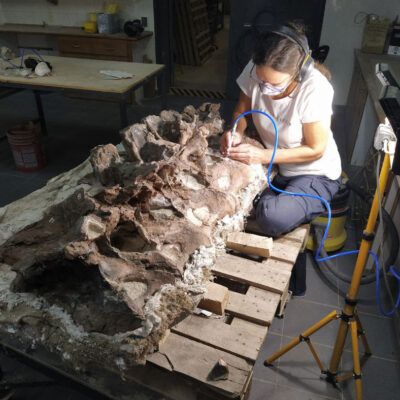
Urwelt-Museum Oberfranken, Bayreuth: A fossil discovery in Mistelgau, Northern Bavaria, Germany, reveals that the last representatives of the giant ichthyosaurs of the genus Temnodontosaurus survived longer in the Southwest German Basin than previously thought. The Early Jurassic marine reptile is exceptionally well-preserved. In addition to injuries in the skeleton of this marine predator, SNSB researchers […]

read more

Palaeontologists Discover New Long-Necked Dinosaur in Patagonia

16. April 2026 | Press Releases

Palaeontology, Munich, 16.04.2026: A German-Argentine team of paleontologists led by SNSB dinosaur expert Oliver Rauhut has discovered a new long-necked dinosaur, Bicharracosaurus dionidei, from the Upper Jurassic period in Argentina, dating back approximately 155 million years. Long-necked dinosaur fossils from the Jurassic period in the Southern Hemisphere are rare, so the new fossil contributes to […]

read more

Surprise in Amber: Exotic Harvestmen Once Lived in Europe

27. March 2026 | Press Releases

Naturkundemuseum Bamberg, 27. March 2026A German-Bulgarian research team led by SNSB paleontologist Christian Bartel has discovered a new species of harvestman in 35-million-year-old Ukrainian and Baltic amber. The animal is related to harvestmen that are now extinct in Europe. The researchers published their findings in the journal Acta Palaeontologica Polonica. The arachnid was perfectly preserved […]

read more

Shell-cracking turtles defied mass extinction at the end of the Cretaceous period

25. March 2026 | Press Releases

Urwelt-Museum Oberfranken, 25.03.2026 The asteroid impact at the end of the Cretaceous period caused one of the largest mass extinctions in Earth’s history. But some organisms defied the catastrophe. For turtles, the chance of survival was apparently linked to their diet: species with a preference for hard-shelled organisms survived the catastrophic event. SNSB paleontologist Serjoscha […]

read more

Christian Bergemann is the new director of the RiesCraterMuseum Nördlingen

3. March 2026 | Press Releases

RiesCraterMuseum Nördlingen, 03.03.2026 Christian Bergemann joined the Bavarian State Collections of Natural History (SNSB) on March 1st. The geoscientist will take over as scientific director of the RiesCraterMuseum Nördlingen, one of the SNSB’s ten natural history museums. He succeeds his long-standing predecessor, Prof. Dr. Stefan Hölzl. Dr. Christian Bergemann most recently headed a research project […]

read more

Versatile answers to drought: Succulent plants protect themselves through a variety of adaptation strategies

24. February 2026 | Press Releases

Botanical Garden Munich-Nymphenburg, 23.02.2026 How do plants adapt to drought and heat? New studies on plants of the Canary Islands show that adaptation is not determined by a single character but by the interaction of entire sets of characters. Even closely related plants can follow very different paths. Apparently, the survival strategies of succulent plants […]

read more

Saltwater crocodiles traveled thousands of kilometers across the Indian Ocean

28. January 2026 | Press Releases

Bavarian State Collection of Zoology, 2026-01-28 A genetic study is rewriting the evolutionary history of the saltwater crocodile and, at the same time, clarifying the species identity of the crocodiles that were exterminated on the Seychelles. The study was published in the journal Royal Society Open Science. Accounts from early expeditions to the Seychelles more […]

read more

Glowing signals in the rainforest: Harvestmen apparently use fluorescent patterns for species recognition

26. January 2026 | Press Releases

Bavarian State Collection of Zoology, 2026-01-26 A research team from Munich has identified a previously unknown communication mechanism in harvestmen. Five closely related species show species-specific, strongly fluorescent structures on their backs that become especially visible under ultraviolet light. The results suggest that these patterns serve for species recognition—particularly at dusk and in moonlight. The […]

read more

Diversity of water striders emerged earlier than previously thought

22. January 2026 | Press Releases

Zoological Collection, 2026-01-22 The diversity of water strider species apparently developed as early as the Cretaceous period, much earlier than previously thought. SNSB researchers have succeeded in clarifying the phylogenetic history of this insect family, with molecular analyses providing comprehensive insights into their relationships and evolution. The study has now been published in the journal […]

read more